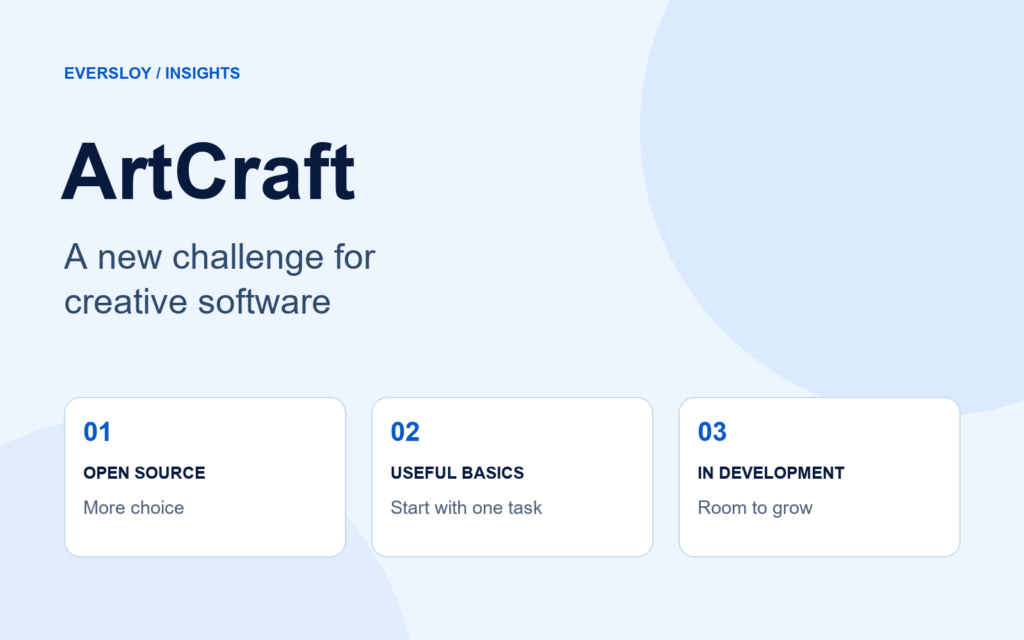
ArtCraft is giving people a reason to look beyond Adobe. Useful basics, open source and still being developed: that is an interesting proposition. The question for a business is where it helps today and where it needs more time.
A challenger worth paying attention to
The latest ArtCraft news challenges an assumption: that familiar creative workflows have to come with the same familiar software subscription. ArtCraft’s Crafting Apps include tools for image editing, vector illustration, video, photography, PDFs, motion graphics and page layout. The team describes them as free, open-source applications built in Rust.
There is an important distinction on that same page. PhotoCraft is labelled early alpha, while several other creative apps are still in development. That makes this an emerging option to explore, rather than a finished replacement for every Adobe workflow. Development status checked on 13 October 2026.
Useful basics still have value
My view is that software does not need to match every feature of an established package to be useful. A business creating straightforward web graphics or preparing images may have very different needs from a studio delivering complex client projects every day.
If a tool handles the job you need, produces the right output and fits the way you work, that has value. The sensible response to early software is to establish those limits. Some tasks may work well; others may expose unfinished features or compatibility gaps. This is a view on the opportunity, not a claim that I have tested the whole suite.
A practical way to try it
One task. Real files. A clear decision.
Choose a task
Start with a small job you understand well.
Test a copy
Check edits, exports and reopening the result.
Judge the fit
Keep what works. Be clear about the limits.
Open source makes the story more interesting
PhotoCraft’s public repository makes its code and development activity visible. That gives technically capable users a way to inspect, contribute to or build on the work. It also makes the project’s progress easier to follow than a product announcement alone.
For a business, I would still look at who maintains the tools, how updates are handled and where help comes from. An open repository is useful, but somebody still needs to own the decision to introduce the software and support the people using it.
Giving Adobe a run for its money?
Potentially—and I welcome the competition. A credible alternative does not have to replace an entire creative department to change the conversation. It might start by doing a smaller set of everyday jobs well enough that people question what they actually need to pay for.
That is where I think ArtCraft becomes interesting. The pressure comes from giving people a workable choice. Whether it becomes a lasting commercial challenge will depend on reliability, compatibility and sustained development. Attention is a start; dependable day-to-day use is what will make the difference.
How I would approach it with a business
I would choose one low-risk task and use copies of real files. Can you make the required changes? Does the exported result look right? Can another person open it? How much extra time goes into working around limitations? Those answers tell you far more than a feature list.
Keep the existing workflow available while you learn. If the alternative earns its place, introduce it where it helps. If it needs more development, revisit it later. There is no need to turn a useful experiment into an all-or-nothing migration.
ArtCraft is worth watching because it offers another choice. My job is to help you work out whether that choice is useful for your business now—and get it working properly when it is.
Assess a tool before committing
Tell me what you need to improve. We will agree the scope, the right service and the next step before work starts.